What is RAG Analysis? How AI Search Engines Find, Cite, and Recommend Information
By PeachSites | July 11, 2026
Artificial Intelligence is changing the way people search for information.
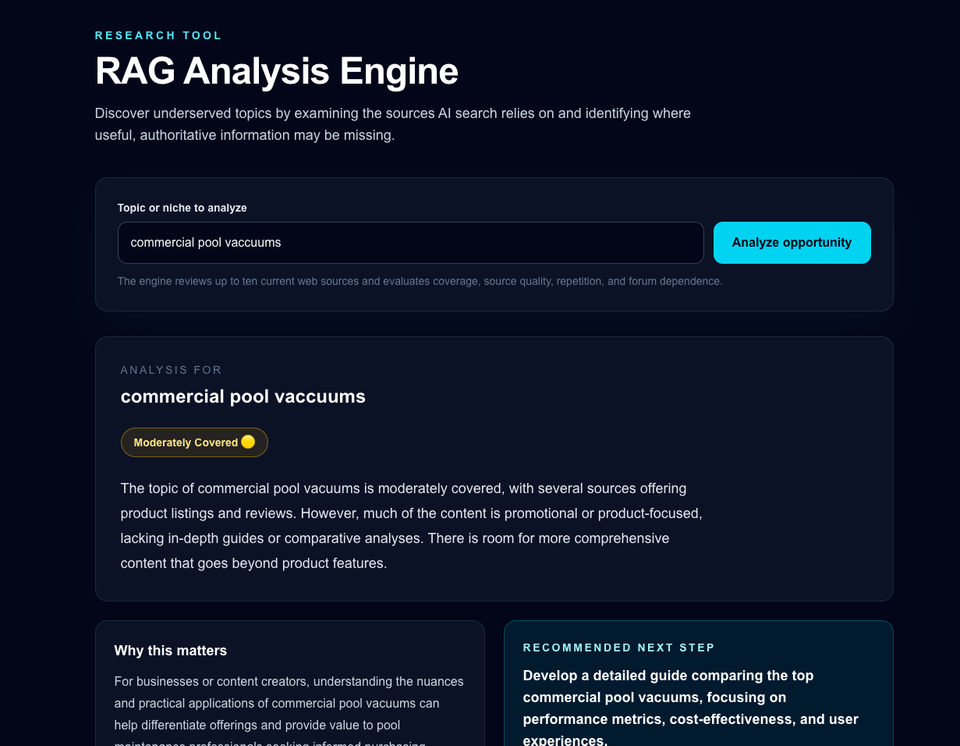
RAG Analysis Engine
Instead of clicking through pages of search results, users increasingly ask AI assistants questions directly. Whether they're using ChatGPT, Gemini, Perplexity, Claude, or AI-powered search, these systems attempt to provide complete answers by retrieving information from multiple sources before generating a response.
Understanding how RAG works can help businesses create better content, improve their online visibility, and identify opportunities where authoritative information is still missing.
What is Retrieval-Augmented Generation (RAG)?
Retrieval-Augmented Generation is an AI technique that combines two processes:
Retrieving relevant information from trusted sources.
Generating a response using that retrieved information.
Instead of relying only on what a language model learned during training, a RAG system searches for current information, evaluates multiple sources, and uses those sources to produce a more informed answer.
In simple terms:
Search first. Generate second.
Why RAG Matters for Businesses
As AI search becomes more common, businesses are no longer competing only for traditional Google rankings. They're also competing to become one of the sources AI systems trust enough to reference.
That raises important questions:
Is my business being mentioned?
Are AI systems finding my content?
Which competitors are being cited?
Are there topics where authoritative information is still missing?
These questions are becoming just as important as traditional SEO.
What Is RAG Analysis?
RAG Analysis examines how AI search engines answer a specific topic.
Instead of measuring rankings, it looks at:
which sources appear
how many sources support an answer
whether AI relies on forums or authoritative websites
potential information gaps
opportunities to create stronger content
The goal isn't simply to generate more content—it's to identify where better information could improve the overall quality of AI search results.
While the RAG Analysis Engine focuses on topics,GEO Pulse focuses on businesses.
GEO Pulse analyzes a website alongside a target keyword to better understand how a business may appear within AI-powered search experiences.
It helps answer questions such as:
Is my website demonstrating topical authority?
Are there opportunities to strengthen AI visibility?
Which content areas deserve more attention?
Together, these tools provide different perspectives on AI discoverability.
What's the Difference Between the RAG Analysis Engine and GEO Pulse?
While both tools are designed to help businesses better understand AI search, they answer different questions.
The RAG Analysis Engine starts with a topic or keyword. It analyzes how AI search engines answer that topic, reviews the sources being cited, identifies potential information gaps, and suggests opportunities to create stronger, more authoritative content.
GEO Pulse, on the other hand, starts with your business. By analyzing your website alongside a target market keyword, it evaluates your online presence and identifies opportunities to strengthen your visibility within AI-powered search experiences.
Think of it this way:
RAG Analysis Engine asks: "Where are the content opportunities?"
GEO Pulse asks: "How can my business become more visible?"
Together, these tools provide a more complete picture of AI discoverability—helping you understand both what information AI is using today and how your business can become part of those future conversations.
AI Search Is Creating New Opportunities
Many businesses have invested years improving traditional SEO.
Now AI search introduces another opportunity: creating content that helps AI systems better understand a subject while providing genuinely useful information for readers.
Businesses that consistently publish clear, trustworthy, and well-structured content may be better positioned as AI search continues to evolve.
Explore the Tools
If you're curious how AI search understands your industry, start with our free research tools: